


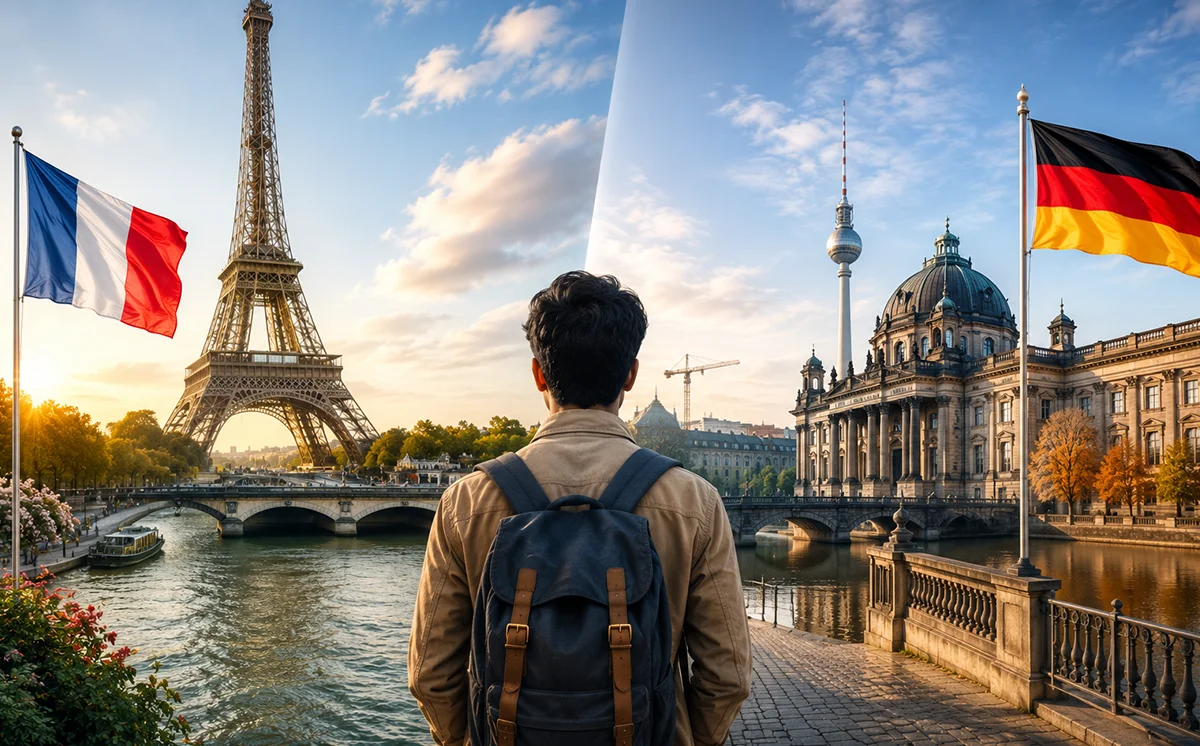
Whether to study in France or study in Germany? The quintessential dilemma of choice between two of Europe’s finest countries. Whether it’s football or food, these two nations have been age-old rivals. However, for this blog, let’s focus on the education aspect of this rivalry. Annually, thousands of Indian students start researching Europe as a study destination and quickly arrive at the educated conclusion of a choice between France and Germany.
Both nations have world-class universities and infrastructure, relatively low tuition fees compared to the UK or US and burgeoning reputations as post-study work destinations. But they’re also very different in ways that matter for students. Their language requirements, visa pathways, job markets and day-to-day costs are chalk and cheese.
The goal of this blog is to help you form your opinion without giving an outright verdict on which country is better. Eventually, you’ll be the one to make that choice – which country is better for your requirements.
A Brief Comparison
Category | Germany | France | Relative Difference |
Tuition Fees | Near zero at public universities; €10,000 to €30,000/year at private universities | Low at public universities: €10,000 to €30,000/year at private universities
| Low |
Language | German (mostly) | French (mostly) | Low |
English programmes | Growing, especially at Masters level | Available, more limited | Moderate |
Post-study work visa | 18 months | 1 year (extendable) | High |
Average student living cost | €850–€1,100/month | €900–€1,200/month | Moderate |
Top strength | Engineering, Sciences, Tech | Business, Arts, Fashion, Sciences | High |
Universities and Academic Reputation
Germany
The thought of studying in Germany for Indian students instantly resonates with some very popular names such as RWTH Aachen, Heidelberg University, TU Munich and the University of Munich. TU Munich and RWTH Aachen consistently rank among the world’s top engineering institutions.
Germany has always been renowned for its exceptional research, and its universities have deep ties with industry giants like Siemens, BMW, SAP and Bosch. This matters enormously and more than what you would initially think without research because it’s crucial when it comes to internships and placements.
France
Indian students’ aim to study in France revolves around the Grandes Écoles system. The system comprises elite institutions like HEC Paris, École Polytechnique and Sciences Po. These are supported by strong public universities like the Sorbonne and Paris-Saclay.
Paris-Saclay is exceptional both in ranking and in practice in mathematics and physical sciences globally. Business, political science, or luxury management are strongholds in France and these programmes genuinely can’t be matched anywhere else, including the big names like the U.S. and the U.K.
So Which Is Better for Engineering, Business and Sciences?
For engineering, it’s undoubtedly Germany. It’s not even particularly close. Similarly, for business and management, it’s France, especially if you’re targeting consulting or finance careers. Where the true comparison lies is in pure sciences. Both countries possess excellent education systems, but France edges ahead in mathematics and Germany is stronger in applied sciences. Eventually, it’s a question of what a student’s core interest area is.
Tuition Fees and Cost of Living
Germany Tuition
Everyone has heard or read about free education in Germany for Indian students. The information is accurate but only for public universities, which charge minimal semester fees of €150–€350. This covers administrative fees, student services and often a public transport pass.
As good as it sounds, there is a caveat to this. You’ll need to have functional knowledge of the German language to study in Germany at a public university. Most undergraduate programmes are taught in German. Studying in Germany without fees for Indian students at the master’s level is more accessible in English, but you’ll still need to demonstrate German language skills for many programmes. The cost of living is not free either.
If you’re specifically looking for programmes taught in English or more flexible entry requirements, Germany also has private universities. These include EU Business School, Berlin School of Business and Innovation and Macromedia University. These institutes charge tuition, typically ranging from €10,000–€30,000 per year. They’re worth considering if the public university route doesn’t fit your profile, but go in with eyes open on the cost, as they tend to add up very fast.
France Tuition
On the other hand, public universities in France charge around €2,770–€3,770 per year for non-EU international students following a 2019 reform. While it may seem high, a closer look reveals that’s a big advantage as it’s significantly lower than the UK or Australia. Private universities and business schools vary widely in France.
Standard private institutions like INSEEC or EM Lyon range from €10,000–€18,000 annually, while the top Grandes Écoles like HEC Paris can go up to €35,000 per year. The most significant advantage at that level is the prestige and industry networks. These connections are very real and very useful, but so is the price tag of making them. Hence, do weigh the career outcomes against the cost before committing.
Cost of Living
The cost of living in Germany for Indian students typically runs €850–€1,100 per month. This will cover rent, food, transport and other basics. Munich is the most expensive city. Leipzig and Dresden are significantly more affordable. Almost all cities are universally safe.
The cost of living in France for Indian students is similar. It’ll cost you €900–€1,200 per month on average. Paris is the most expensive, and cities like Lyon, Toulouse and Bordeaux are noticeably cheaper and still have strong universities and job markets. The safety is at par with Germany.
What we can tell you for sure is that neither country is dramatically cheaper than the other. But if you did have to make an educated choice, then Germany edges ahead slightly overall, especially outside major cities.
We Need To Talk About The Language
Language is the biggest elephant in the room when you’re going to study in a country where English is not the majority language. In Germany, the majority of Bachelor’s programmes are in German. English-taught programs in Germany vs France are more widely available at the Master’s level in Germany.
Yet, even then, you’ll notice that daily life is cumbersome at best without knowing the language. Finding accommodation, visiting a doctor, dealing with bureaucracy is much easier with at least conversational German. Imagine living in New Delhi and having no knowledge about Hindi? The IELTS requirement for Germany vs France varies by institution, but most English-taught Masters programmes in both countries require IELTS 6.5 or equivalent.
France shares a similar environment. Outside of specific international programmes, French is essential for daily life and for most undergraduate study. If you don’t speak French, you’ll find yourself limited to a narrower pool of programmes in both countries. Your social life too will be held hostage to this skill gap and university is as much about networking as it is about your programming.
So here’s the most honest advice. You have to be willing to learn either language at a functional level before you’re serious about going to Germany or France. You could still manage it, but knowing the language is infinitely the better choice.
Student Visa: France vs Germany
The France student visa for Indian students (the VLS-TS) is processed through Campus France. It’s a French government body that manages the application process. It’s orderly, structured and Indian students have a good track record with approvals when documentation is in order.
The German student visa for Indian students requires proof of admission, financial means in the form of a blocked account of around €11,208 per year and health insurance. The processing times can vary between 6–12 weeks and early applications are quite important.
Visa wise, both application procedures are manageable. Neither is particularly easy, but with the right preparation, approval rates for genuine applicants are solid.
Part-Time Work Rights & Post-Study Work and Job Opportunities
Both Germany and France allow international students to work. Students can work for 20 hours weekly during term time. In Germany, part time jobs can become permanent jobs through Werkstudent roles directly related to your field.
In France, part-time jobs are harder to find without French language skills outside of international company environments. Arguably, this is one of the most significant differences in the France vs Germany debate.
Job opportunities in Germany after studies are strong.
- Germany has an acknowledged skilled worker shortage and the government has actively expanded pathways for international graduates.
- The 18-month job seeker visa gives you meaningful time to find work. Salaries for engineering and tech roles range from €45,000–€65,000 at entry level. These salaries are often higher in cities like Munich and Frankfurt.
- PR after studying in Germany for Indians is very achievable. It’s typically after 2–4 years of skilled employment and depends on the route taken. Job opportunities in France after studies are good.
- The most popular industries are consulting, finance and tech. Yet, the job market is more competitive and French language skills are almost always required for non-international company roles.
- The post-study visa (APS) gives one year initially. It’s extendable based on employment.
For MS in Germany vs France for Indian students specifically, Germany offers stronger outcomes in engineering and tech. France holds its own in business and finance and is great for those targeting global firms with European headquarters in Paris.
A Nuanced Approach
The France vs Germany debate doesn’t have a universal answer, and the best choice can only be made through a nuanced approach. Any other approach is just an oversimplification. Germany is stronger in engineering and technology, while France leads in business, arts and political science.
Recent years have shown that Germany offers a clearer PR pathway and a longer post-study visa, while France is unmatched for specific sectors like consulting and luxury industries.
On living costs, both countries have a similar price range of €850–€1,200 per month. On this account, Germany is slightly more affordable outside the major cities. On the PR front, both pathways exist, but Germany’s is more clearly defined and generally faster for skilled workers. Recent recorded trends back this.
More than searching for a general answer, you must make a comparison that serves your purpose and is the right choice for you. Based on what you want to study, how comfortable you are with language learning and what kind of career you’re building toward. That’s the only correct way of looking at this choice.
In fact, it is not just about choosing between France vs Germany. The argument holds true for anywhere in Europe, as there are a lot of moving parts. The programme includes shortlisting, language preparation, visa documentation, financial planning, visa regulations and application strategy.
At Silver Fern Education Consultants, we’ve helped students navigate decisions likes these countless times. We work with you to understand your academic background, career goals and personal preferences and only then help you build an application that actually stands out.
Studying in Europe for Indian students is more accessible than most families realise. If you take the comparison seriously, do your research and take a methodical approach, you’ll be very well placed to succeed in one of the most prosperous regions of Europe in a manner suited to you.
FAQs
Germany is cheaper. Public universities charge little to no tuition, while living costs are also lower than in French cities like Paris.
Not always. Many courses (especially master’s programs) are taught in English. But learning the local language helps with daily life and jobs.
Germany offers an 18-month post-study work visa and strong demand in engineering and tech. France offers a 1-year permit, with good options in business and fashion.