




Are you planning to study abroad at one of the top-ranked universities worldwide? Well, if that is your ambition, you surely know by now that it is easier said than done. Admissions at top universities are highly competitive, and only the best of the best make the cut. You must be exceptional to crack institutions like Imperial College London, the University of Sydney, New York University, the University of Toronto and so on. Here, “exceptional” means both academic performance and overall profile.
However, the question is, how do you show the university that you are an outstanding student? The most obvious answer is your CV that will speak for the academic record and everything else you’ve done as a student. However, there’s one more important thing that is both a necessity and a key difference. Yes, we are talking about a Letter of Recommendation (LOR) for study abroad.
A strong letter of recommendation puts great weight behind your study abroad application. It tells the universities’ admission officers about your potential, achievements, experiences, and diligence. A good LOR should endorse a journey of holistic development. The best part is that it speaks for you from the viewpoint of your teachers, counsellors or previous employers, hence adding great credibility to your candidature.
It would be correct to say that an LOR can be the make-or-break dimension of your entire study abroad application. Irrespective of whether you want to study in Canada, Australia, the UK or any other country, a compelling and genuine LOR is a must! So, you must know what a good LOR entails and how it should be written. This blog offers a complete guide on the same. This is your ultimate handbook to writing a great LOR!
Types of Letter of Recommend
In our guide, we have covered both academic LORs and professional LORs, explaining the key approaches systematically. While an academic LOR comes from a faculty member, school counsellor or dean, a professional LOR comes from an employer. Let’s delve deep into the details of both these types of LORs and how to go about them.
Academic LOR
An academic letter of recommendation should be written by a dean, department head, or a professor from your college or university. It offers an overview of your achievements, academic performance, and strengths. An academic recommendation letter must be issued on the university or college letterhead. If you are going for an undergraduate programme, you will need an academic LOR from a subject teacher at the school, a school counsellor or the principal.
An academic LOR is an essential document for students planning to study abroad. Most esteemed universities ask for two to three LORs, which should all be distinct yet relevant to the applied programme. So, for instance, if you are going to apply for a mechatronics engineering programme for your bachelor’s, you can get LORs from your maths and physics teachers. Alternatively, you can get one LOR from your principal and one from a subject teacher.
Professional LOR
A professional letter of recommendation is a document issued by your former employer or reporting manager. Most employers abroad require a set number of LORs and work experience from the applicant. This LOR is different from an academic LOR, as it is more focused on work experience and covers your professional and leadership skills. Additionally, a professional letter of recommendation is only issued on the employer’s letterhead, duly signed, and stamped.
How to Structure a Strong LOR
The academic letter of recommendation structure is a crucial element, and its content makes a huge difference. An ideal academic letter of recommendation must have:
- Relevant research and project work
- Co-curricular initiatives
- Academic performance record
- Achievements
- Incidents supporting expertise in work ethic
A professional letter of recommendation mainly focuses on:
- Candidate’s leadership skills
- Soft skills
- Area of expertise
- Your strength as a professional
Thinking of what a strong letter of recommendation looks like? It covers the following:
- Answer “Why this programme”: relate the applicant’s skills to the university’s programme they are applying for. Elaborate on how their research interests align with the professor’s work and why their experience and knowledge make them a strong fit for that course.
- Try to mention improvement in numbers: instead of directly mentioning your scores, you can explain briefly how you managed to score 20% more this semester and what approach led to this improvement. Growth over time supports the candidate’s growth mindset and their ability to learn.
- Be as specific as possible: try to avoid words such as “amazing” or “excellent”, but rather use “stronger analytical skills” or “possesses extraordinary soft skills despite being an undergraduate”.
- Mention incidents that shaped your personality: Universities like to see how you cope with certain situations and perceive them positively. You can use examples such as balancing studies with part-time jobs, supporting your family financially, and still earning academic awards.
SOP vs LOR: What's the Difference?
If your brain assumes that SOP and LOR are quite similar documents, this article will help you understand the difference between the two.
SOP stands for statement of purpose and is written by the applicant. It often covers the candidate’s academic background, reasons for choosing a programme, personal experiences, and career goals.
Whereas a letter of recommendation is written by a professor, dean, or employer who has observed your work and personality. It offers an external perspective and objective evaluation of the candidate’s character, potential, and abilities. A letter of recommendation is believed to have more credibility and is often asked by future employer or universities while joining them.
Who Should Write Your LOR (Professor Vs Employer)
Graduates often get confused about whom they should ask for an LOR: a professor or an employer? The ideal approach is to understand what each of them could offer and how it will be helpful in your application process.
An LOR from a professor and an employer both have their own significance; let us help you understand the difference and significance of both.
| Factors | LOR By Professor | LOR By Employer |
| Known as | Academic LOR | Professional LOR |
| Written by | Professor, tutor, dean, or mentor | Manager, team lead, or workplace supervisor |
| Best for | Graduates and research-focused programme | Experienced candidates and professionally focused courses |
| Covers | Academic records and readiness for advanced study | Professional development and workplace skills |
| Suitability for PhD applicants | Strongly required | May support your application. |
| Mentioned key skills | Projects, grades, class performance, and research writing | Responsibilities, leadership, achievements, and teamwork |
| Ideal referee would be | Someone who mentored your academic performance | Someone who mentored or supervised your work |
Who should write your LOR? The answer to this question depends on the purpose of your letter of recommendation. This article mainly focuses on assisting students planning to study abroad; thus, the applicant should get the LOR from their professor or university dean.
LOR Format for Masters Abroad
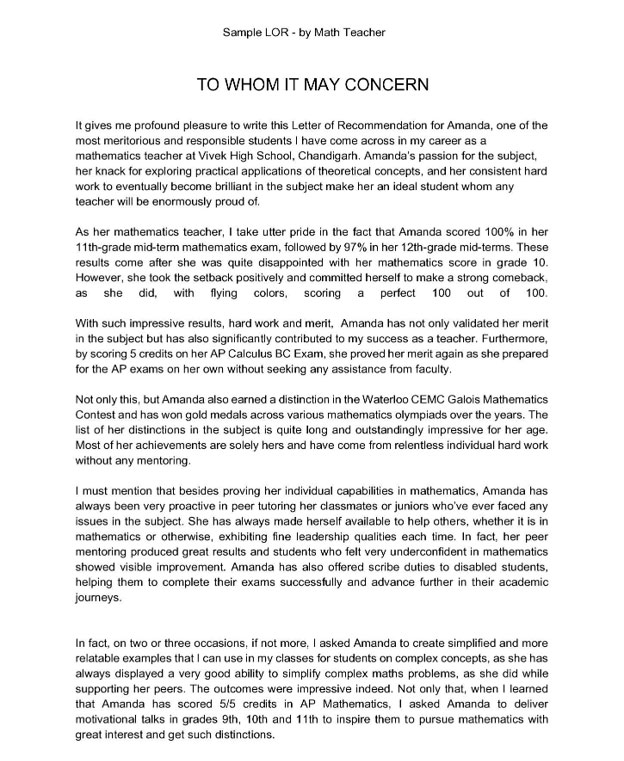
An LOR format for university admission is an important aspect, as universities follow certain sections. Each section serves its purpose and requests measurable evidence. A strong letter of recommendation for study abroad includes the following sections:
Letterhead and date: Institution’s letterhead with date
Salutation: This section can include “To the admissions committee” or can be written as “To whom it may concern”.
Introduction: Name of the recommender, their role, and how they know the applicant and since when
Body: Academic records, work performance, achievements, and skills with real examples
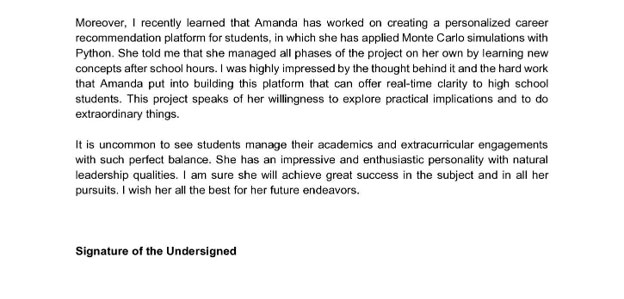
Personal qualities: the candidate’s character, team spirit, and leadership qualities, supported by real instances
Signature and endorsement: A clear recommendation. Referee’s name, signature, designation, and contact information.
A sample LOR is included below for your reference.
Winding Up
Writing a strong letter of recommendation for study abroad students may not be an easy task, but with a proper guide, it often becomes easy. A strong LOR plays a crucial role in the admission process. It provides a first-hand view of you, beyond your work and academic achievements. Ask your recommender to be specific and avoid being generic; mention measurable achievements, and avoid adding any information that doesn’t resonate with the course or programme you are applying for. Use professional language and tone as it develops the credibility of the document.
FAQs
A strong LOR often comes from a professor, manager, dean, or project mentor.
Most universities request two to three recommendation letters, distinct from each other yet relevant to the programme you applied for.
Yes, you can submit the same LORs to different universities since it is seen as an official document.
No, this is highly discouraged and should not be practised, as it is unethical and can also lead to disqualification. Struggling to get a letter of recommendation?